Introduction
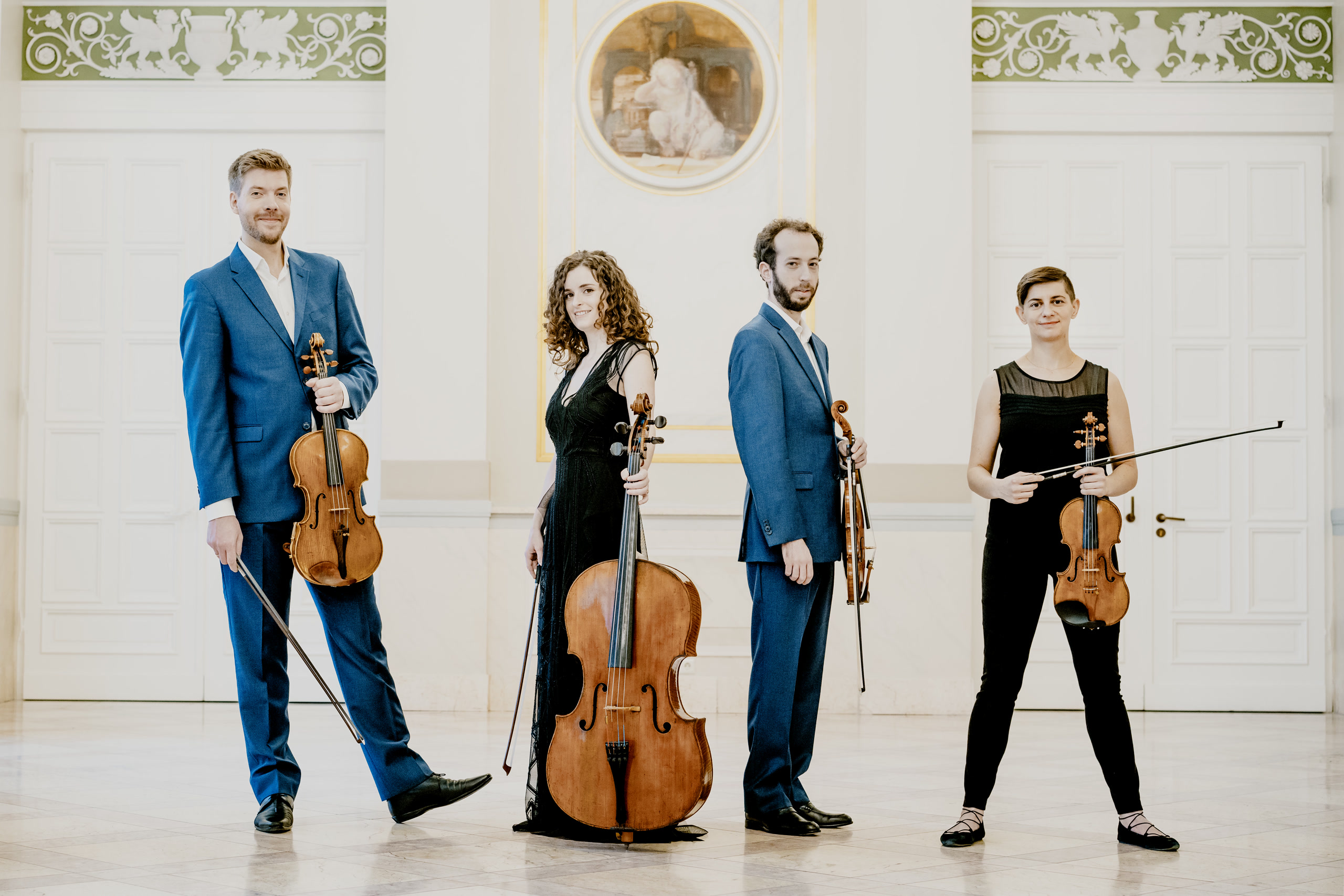
In 2013, as we were celebrating the quartet's fifteenth anniversary, we fulfilled one of our dreams and performed our first Beethoven cycle. Since then we are performing it regularly and continue to be enthralled by the infinite depth of this masterful set of works. We've always been fascinated by Beethoven as a composer and his quartets in particular as they represent some of the most transcendent music ever written. Playing the seventeen quartets as a whole, we feel that we become part of a personal life-long journey reflected in Beethoven's music.
The Cycle was and continues to be a wonderful project for us, and we love presenting it in many different ways - from an incredibly intense 5 concert version in 3 days, to stretched over several seasons like our recently concluded 2018-2022 multi-year project for the ArtPower! initiative at UCSD San Diego.
We look forward to performing these quartets for many years to come since our perception of them never stays the same and we continuously grow through them.
On our YouTube channel you can find recordings from the first Cycle we performed during the 2013/14 season at the University of Cincinnati College-Conservatory of Music, and for an extensive taste of the work we did for ArtPower! please check out their YouTube channel, featuring very recent recordings of op. 18/3, 18/5, 59/1, 59/2, 130 and the monumental op. 131.
Early Period
The string quartets Op.18 were published as a set of six, following a tradition instigated by Haydn and Mozart, who in turn dedicated sets of six string quartets to one another. Arriving in Vienna in 1792, Beethoven avoided the genre for close to eight years, during which time he focused mainly on writing piano music before creating this set of quartets.
Strongly influenced by Haydn and Mozart, the works follow the classical tradition yet boast of typically idiosyncratic Beethovenian character, full of unexpected turns and unconventional modulations. We love opening programs with any of the Op.18 quartets as they immediately establish a very intimate and direct connection between us and the audience.
Quartet in F major, Op. 18, No. 1
The second movement of this quartet for us is one that – knowing Beethoven's compositional evolution – reaches far into the future and anticipates some of the intense flavors that are explored in the slow movements of string quartets written later on.
Quartet in G major, Op. 18, No. 2
This quartet has famously been nicknamed "Komplimentierquartett" ("Compliments"), in reference to its typically Viennese spirit as well as to Haydn's string quartet Op.77, No. 1. Did Beethoven mean to symbolically take his hat off to the classical tradition?
This fourth movement is one of the most fun things to play on stage and we usually can't wait to get to it and release all the joy of this music.
Quartet in D major, Op. 18, No. 3
Published not strictly in the order of conception, this quartet was the first of the Op. 18 quartets that Beethoven wrote.
Quartet in C minor, Op. 18, No. 4
This was the first Beethoven quartet we ever played when we were 14 years old. Connecting with this music at such a young age laid the cornerstone for our passion not only for music in general, but specifically for Beethoven's work. It created many special memories and makes it easy to recall our musical roots and origins.
The Op. 18, No. 4, quartet embodies by far the darkest and most turbulent composition of the Op. 18 quartets. Although its character is distinctively juxtaposed by a light and innocent middle movement, you can get a taste of the inner turmoil that prevails over Beethoven's state of mind.
Quartet in A major, Op. 18, No. 5
With this joyous and celebratory quartet Beethoven pays homage to Mozart's string quartet in A major, K. 464. Parallels are evident not only in the choice of key, but also through similarities in the movement descriptions and by featuring a Menuetto as a second movement as well as a variation-based third movement, just to name a few. We are not quite sure why this piece is so seldomly programmed (apart from the obvious reason of course: it's hard) - we love playing it and think that it stands out of the set with a humor that Mozart would have written to his father and sister about.
Quartet in B flat major, Op. 18, No. 6
Displaying a wonderfully buoyant and lively first movement, this quartet also has the most intricate last movement of all of the Op. 18 quartets and definitely hints at what was to follow this magnificent set in the middle and late periods of Beethoven's string quartet output.
The third movement of this piece features such challenging cross rhythms that although we know this music like the home screens of our iPhones, we still occasionally get confused as to the whereabouts of the downbeat.
Middle Period
Quartet in F major, Op. 59, No. 1
Honoring Russian Count Razumovsky, who commissioned the three Op. 59 quartets, Beethoven included a Russian theme in each work of this set (most prominently so in the first two works). By close to doubling the performance time per piece, the sheer size and magnitude of these compositions poses a stark contrast to his earlier works. Beethoven puts great emphasis on the intense and elaborate slow movements, allowing them to become to some extent the center of attention and the heart of the piece.
Quartet in E minor, Op. 59, No. 2
Highly charged and nerve-wracking in its ferocity, the first movement of this quartet arguably continues to command great respect from the most experienced of string quartet players, epitomizing one of the most intricate and challenging compositions in the repertoire.
Quartet in C major, Op. 59, No. 3
Starting with a confusingly mystical and searching introduction, this piece reveals its heroic and life-affirming character when entering the main movement through two cadenzas of the first violin and one of these unexpected turns Beethoven loves to confront us with.
Quartet in E-flat major, Op. 74
Featuring another slow introduction, if slightly more melodic and tangible in character, and nicknamed the "Harp" for its pizzicato sections, the first movement of this quartet is full of triumphant and warm-hearted spirit.
Quartet in F minor, Op. 95
One of the shortest and most compact of all of Beethoven's string quartets, this work - entitled "Quartetto Serioso" - is the last of the quartets attributed to the Middle Period and was "written for a small circle of connoisseurs and [...] never to be performed in public" (Beethoven in a letter dated from October 7th 1816 to Sir George Smart). Ever-evolving at a nearly incomprehensible pace, Beethoven exhibits extreme use of silences, sudden and extreme dramatic outbursts as well as metric ambiguity (to name only a few).
Late Period
Quartet in E-flat major, Op. 127
It took Beethoven close to fourteen years to return to the string quartet genre with this marvellous and exuberant work, once more drastically expanding the form and disregarding all conventional boundaries. According to Christian Schubart, the key of E-flat major is "The key of love, of devotion of intimate conversation with God; through its three flats expressing the holy trinity." Not to be understood in any conventionally religious context, the piece overall surely radiates Beethoven's own genuine spirituality and thoroughly conveys that "Ode to Joy" spirit so familiar to us from his 9th symphony (Op. 125).
For this very spirit, Op .127 for us is one of the most fun and rewarding Beethoven quartets to perform.
Quartet in B-flat major, Op. 130
Op. 130, 131, and 132 were commissioned by and are dedicated to Prince Galitzin, another Russian nobleman and supporter of Beethoven. They are intimately related through their compositional DNA and represent the heart of Beethoven's Late Period quartet oeuvre.
So much incredible music has been written for the string quartet genre by so many brilliant composers, but ultimately these pieces are beyond any doubt some of the main reasons why we do what we do and can not imagine doing anything else.
Große Fuge in B-flat major, Op. 133
Featuring the eternal Cavatina as its fifth movement, the Große Fuge, Op.133, was originally meant to be the sixth and last movement of the monumental Op. 130. His heightened interest in composing fugues during this artistic period led Beethoven to writing this mother of all fugues. His peers, however, weren't entirely ready to accept this futuristic and "forever contemporary" (Igor Stravinsky) piece of music, which eventually led to it receiving its own opus number and standing amongst Beethoven's string quartets.
At this point, we find it hard to imagine any other piece of music following the Cavatina, which is why we much prefer to program the works according to their original conception.
Performing the Fugue, when we get to the last page that repeats (if slightly varied) its opening, an intense feeling of joy overcomes us and releasing all the built-up tension into the Coda that brings all elements together in perfect harmony equals for us one of the most gratifying moments of music-making.
Quartet in C-sharp minor, Op. 131
The physical structure of all three late works is absolutely unconventional and revolutionary in every respect. Op. 131, however, takes the crown by consisting of seven movements, each following another without any break or interruption. The effect is that the listener is taken by the nose and forced to go through some kind of Aristotelian catharsis experiencing consecutive worlds of contrasting characters and multifaceted emotions. It is also said to be Beethoven's favorite amongst his own string quartets.
The experience of performing this work (as well as Op. 130 and Op. 132) reminds us that it is necessary for musicians to physically stay in shape and provides us with a bizarre and feverish mix of feelings somewhere between a neverending story and being over too quickly.
Quartet in A minor, Op. 132
This quartet's introduction unveils the otherworldly modal DNA that runs in the blood of Op. 130 and Op. 131 right from the start. The heart of the piece is the third movement, which alternates slow choral-like sections with upbeat and life-celebrating intermezzi. Beethoven concludes the work by means of an epically massive Coda that (much like in Op. 59, No. 3) functions as a coda for all three quartets of this set.
We feel a deep connection to this work as it is the first of the Late Period Beethoven quartets we learned and performed (at times even by heart). It will always revive a sense of our student days in Boston and remind us of our great experience at the Banff Competition in Canada.
Quartet in F major, Op. 135
With his last string quartet Beethoven in some ways reverts back to the roots: it is much shorter than the other late quartets, in fact one of the shortest of all 16 (or 17, depending on how one counts). Primarily because of the choice of the F major key signature (like 18/1 and 59/1) some scholars believe this might have been intended to open another set of quartets.
With its cheerful first, an exhilarated second, and the deeply introvert third movement, we experience a transfigured Beethoven delivering us the final clarification through the fourth movement, entitled "The difficult decision – Must it be? It must be!"
We find this quartet to be one of the harder Beethovens (but then again they all are!): it combines the cleanliness and exposure of the Op. 18 with the depth of Beethoven's Late Period writing, and all of that in a disarmingly simplistic approach. We had to gather some experience before we really got the hang of this outstanding work.
The Cycle was and continues to be a wonderful project for us and Beethoven's final and affirmative "It must be!" certainly makes for an invigorating and inspiring Credo!